An ancient treasure chest of music
By Dorothy Cummings McLean
December 7, 2011
Dorothy Cummings McLean
Living as I do across the Atlantic Ocean, I still manage to keep abreast of events in Toronto. The Internet is like a seashell, sighing in my ear.
The most recent news is that St. Michael’s Cathedral is altering the order of its famous music, provided since 1937 by St. Michael’s Choir School.
This news sent me scampering to a cardboard box in the closet. When I left for Britain, I abandoned clothes and packed books and papers. Textual relics of high school and university took precedence. “History,” one university-era housemate once said, “is text.”
History is also music, and I rifled through the box looking for old Cathedral parish bulletins. When I was a child, a teenager, a young woman, the music for the vigil and Sunday Masses at the Cathedral was carefully typed inside the bulletin. After the processional hymn was the Introit, sung in a great triumphant burst by whichever choir — Junior, Senior, Tenor-Bass — was serving at that particular Mass.
I did not know then that the Introit had itself been the processional hymn for over a thousand years.
This is the kind of thing I know now because my husband is a chorister for Edinburgh’s Extraordinary Form of the Mass. Sunday after Sunday the Schola sings the traditional order of Mass music as it was known by Palestrina, Victoria, Mozart, Poulenc and every Western Christian composer until the 1960s: Introit, Kyrie, Gloria, Gradual, Offertory, Communion. Occasionally the organist sneaks in an English recessional hymn, which we all enjoy, as even liturgical traditionalists love to bellow a good hymn now and again.
But the joy of the St. Michael’s Cathedral choir program was that it combined beautifully both the ancient musical treasures of the 1,900 years of the pre-Conciliar period and the innovations of the 25 years of the post-Conciliar period. As the Council document “Sacrosanctam Concilium” requested, it gave pride of place to Gregorian Chant. But it also made room for the congregation to sing at least a processional hymn, a communion hymn and a recessional hymn. The congregation also sang the Nicene Creed according to the simple and beautiful music known best as “Credo III.” That was very lucky for globetrotting me, for although local hymns change from country to country, every Roman Catholic congregation in Christendom seems still to know Credo III.
It was also a joy that the choir would sometimes sing alone. There has, of course, been a lot of liturgical wrangling over the expression “active participation” in the Mass. However, “actuosa participatio” does not mean extraordinary activities or busyness in church services but an interior state of attention and receptivity to the unfolding mysteries. (If you’re sneaking peaks at the bulletin between hymns, you are not in a state of active participation.) When the choir sang an Introit or a Gradual or a Communion antiphon by Tomas Luis de Victoria on our behalf, we in the congregation were jolted out of ourselves and the distractions of the world by sheer beauty.
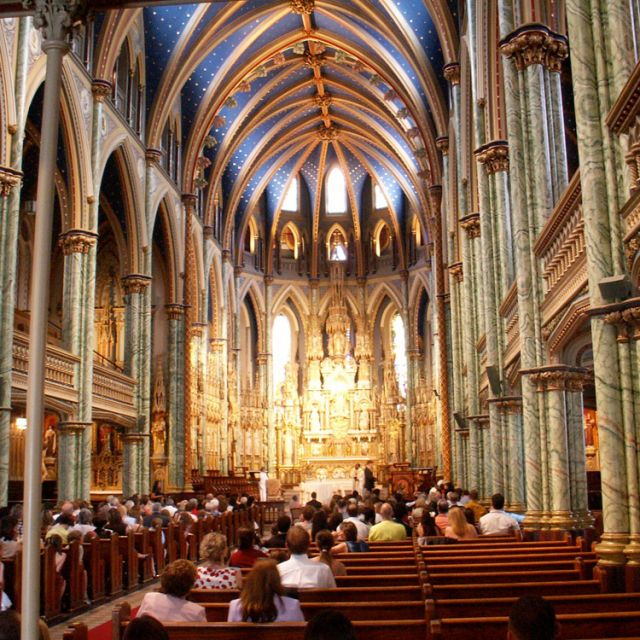
“Late have I loved thee, O Beauty, so ancient and so new,” prayed St. Augustine in Confessions, and it is an ancient idea that the beauty found in Creation mirrors the beauty of God. It was no doubt for this reason that Catholic artists and artisans have worked so carefully to create churches, objects and music of great beauty for liturgical services. Beauty, especially beautiful music, has the power to bring us closer to God and, in a way even more mysterious, to each other. People do not usually converse during an aria or before a splendid painting or while staring up at the ceiling of an immense cathedral, but we do like to have someone else with us, so we can say, “Wasn’t that beautiful?” When I was a teenager, busloads of American tourists would come to the Cathedral for Sunday Mass and depart sighing, “Wasn’t that beautiful?”
Sadly, I could not find an old Cathedral parish bulletin. (I do hope Cathedral bulletins are filed away somewhere, for the sake of Church historians of the future.) What I have found is a program for the St. Michael’s Choir School Christmas Concert for 1985. Kathleen Mann and Fr. T. Barrett Armstrong — whose names should sound as loudly in the history of the Church in Toronto as those of archbishops for their service to that Church — directed the Junior Choir and the Senior Choir respectively.
The program was a diverse one, offering carols and hymns both traditional and modern, English, French and Latin, and it reminds me of the Cathedral liturgies of old. There was room for both F. Bernard’s “Winter Wonderland” and Telemann’s “Laudate Jehovam, Omnes Gentes.” There was room for the fun and for the sublime.
And in the face of current changes, I hope the sublime will be allowed to sing out at St. Michael’s Cathedral for centuries to come.
Dorothy Cummings McLean