Students get up close, personal at Vimy Ridge
By Evan Boudreau, The Catholic Register
April 17, 2012
Education
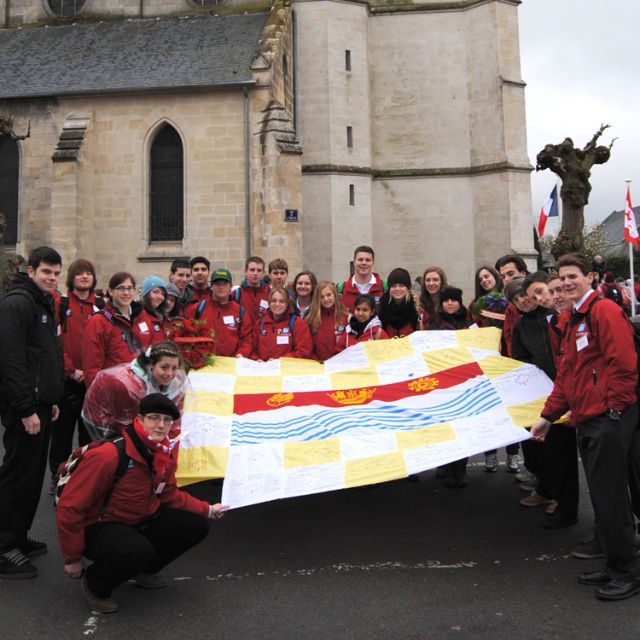
Twenty-five students from Barrie, Ont.’s St. Joseph’s Catholic High School experienced an Easter to remember as they travelled to France on a Remembering Vimy Ridge trip.
Accompanied by history teacher Trevor Carter, the students experienced a seven-day history class.
“The students did realize the sacrifice of the soldiers when they were sacrificing their comfort,” said Carter, describing the Easter Monday weather as typical for Normandy, France — wet, windy and cold. “But it was easy to handle the weather when you took into account what happened there 95 years ago.”
Organized by Education First Tours, who for the past 45 years have facilitated national and international student trips, this year’s journey to France brought 147 groups from across the country together for a common purpose: to remember those who sacrificed their lives for the freedom of our then young nation.
Carter reiterated this point, stressing that the trip, which cost students about $2,500, differed from vacation-style endeavours to New York which are popular in high schools.
“There’s a lot of pleasure trips the students do. Of course they experience some of the history there but the whole point is to experience everything,” said Carter, who has visited Vimy Ridge four times. “Our trip was a little different. We chose students that wanted to go for the history first and foremost.”
To qualify a student needed one of two credentials: a personal connection to either of the world wars or a genuine interest in history.
Once selected students were required to produce an extra-curricular research package on a soldier, or in some ambitious cases, soldiers. After spending a year learning about a soldier, their experience of sacrifice and the untimely cause of death, some students got a little emotional during part one of the memorial service, visiting the graves.
“They didn’t just find the soldier’s name and where they’d been buried; they knew all that,” said Carter. “But the epitaphs at the bottom of the graves would sometimes surprise them. A few students were a little bit choked up by some of the things that parents back home chose to have written on these grave sites.”
One verse which Carter said touched nearly every student was that etched into the white stone representing the resting place of a 17-year-old boy. His marker read, “He was a boy trying to do a man’s job.”
Education