Celebrating in different languages, Pope sees translation troubles
By Catholic News Service
April 26, 2012
WASHINGTON - Pope Benedict XVI told the German bishops that, as Pope, he has celebrated Mass in different languages and "sometimes it is hard to find common ground" in the various translations.
"The underlying common text often remains visible only from afar," he told the bishops, who were preparing to send their revised Mass translation to the printers.
In a letter dated April 14 and posted on the German bishops' website April 24, Pope Benedict said that, over the years, it has become "increasingly clear" to him that not translating liturgical texts literally creates difficulties.
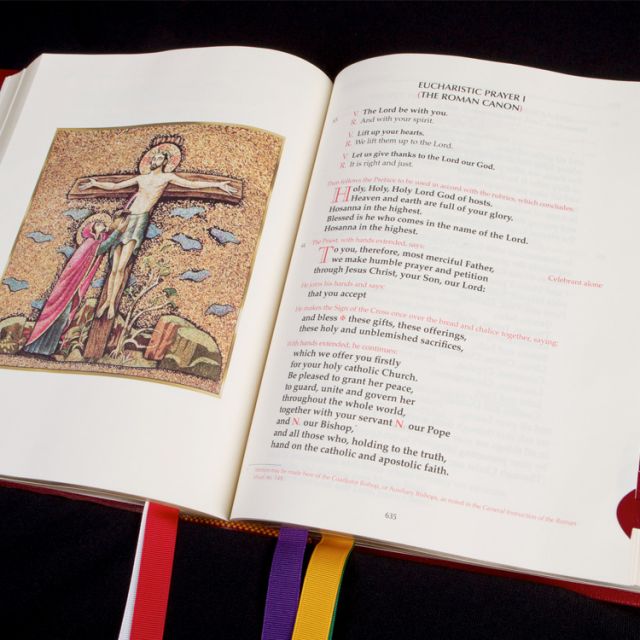
The Pope's letter was aimed specifically at the translation of the phrase "pro multis" in the eucharistic prayer where Jesus told the disciples to take the chalice of his blood, which was poured out "pro multis." The phrase used to be translated in English, German, Italian and other languages as "for all," but in 2006 the Congregation for Divine Worship and the Sacraments sent bishops around the world a note saying Pope Benedict had ordered Catholics to use the more literal translation, "for many."
While the bishops of Germany adopted "for many," other German-speaking bishops' conferences continued to debate whether to translate the phrase literally or in a way that reflects Catholic faith that Jesus died to redeem all. The Pope's letter did not name the other bishops' conferences, although both Austria and Switzerland use German liturgical translations.
In his letter to the German bishops, the Pope said "for many" is the correct translation from Hebrew and Latin, and using the equivalent in every language would ensure the unity of Catholics around the world in celebrating the core moment of Catholic prayer.
When the Latin texts of the Mass were being translated into the different languages of the Catholic people beginning in the 1960s, he said, most translations used "all." Because translators were eager to formulate the Latin texts into comprehensible versions of the different languages, they also slipped in some interpretation rather than simple translations, the Pope wrote.
With the text in question, he said, translators had wanted to clarify that Jesus did not die only for a special group, but for all people.
The Pope said he knew how the change could affect the Catholic faithful: "They will ask: 'Did Christ not die for all of us? Has the church changed its teaching?... Is this a reactionary attempt to destroy the (Second Vatican) council's heritage?'"
The change "demands a profound catechesis for the Catholics to make them understand," he said.
The phrase "for many" was chosen primarily because it matches the most common translation of the Gospel words of Jesus at the Last Supper, he said. "Veneration for the word of Jesus is the reason for this formulation."
While Jesus came to save all humanity -- past, present and future -- the community gathered for Mass is only "many," he said.
"The many bear responsibility for all," he wrote.
In a statement on the German bishops' website, Archbishop Robert Zollitsch of Freiburg, president of the German bishops' conference, said the Pope's letter "provides clarification and brings an end to the discussion," while also serving as an encouragement to move forward in getting the new missal into parishes and educating Catholics about the changes it will contain.