Catholicism still matters in Poland
By Dorothy Cummings McLean
May 15, 2012
Dorothy Cummings McLean
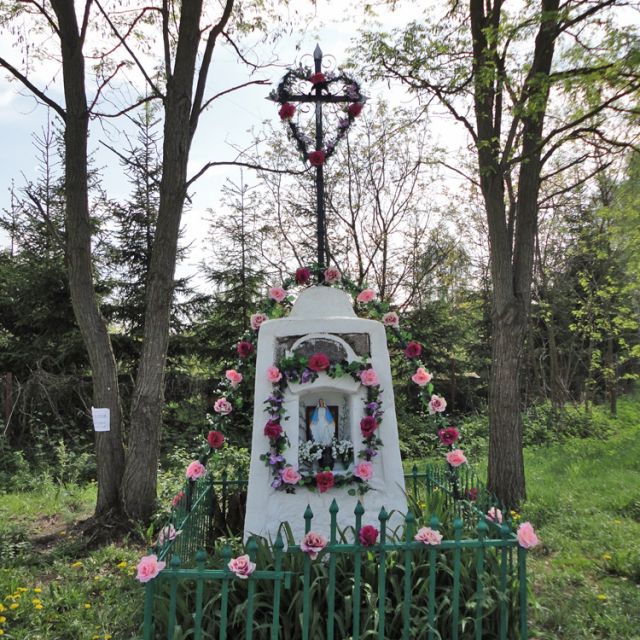
The first week of May is not usually warm and sunny in Poland, but it certainly was this year. I spent its Saturday morning bicycling around the countryside south of Warsaw with my friend Weronika. The roads, dirt or tarmac, were almost innocent of traffic, and I got off my bike at almost every crossroad to take yet another photograph of yet another roadside shrine.
“You’re supposed to pray at them, not photograph them,” scolded Weronika.
“Oh, yes,” I said shamefacedly and said a short prayer.
Most of the shrines were in honour of Our Lady and had been newly decorated on the first of May. The first of May is a holiday in Poland, a survival of communist days, but the third of May holiday is the Feast of Mary, Queen of Poland. Reproductions of the Black Madonna of Czestochowa, beautiful and scarred, can be found everywhere: on shrines, in homes, in churches and in the dining halls of retreat centres.
I had become familiar with a dining hall in a retreat centre to the south, in Krakow, where I gave four lectures on the topics of women and the single life. It was a women’s retreat, and to my surprise, I was told that there aren’t many women-only retreats in Poland. There are youth retreats, marriage encounter retreats, retreats for priests and retreats for the elderly, but the idea of a retreat just for women, let alone single women, was apparently a novel one. Seventy women of different ages, but most in their 20s or 30s, spent their May holidays at ours. Needless to say, I was provided with a translator.
My translator couldn’t go with me everywhere, of course, so I had to depend on my own rudimentary Polish, on the English of others, and on my very handy English-Polish missal. I had bought this at the back of St. Mary’s Cathedral in Edinburgh; it was designed to help Polish-speakers understand the Mass in English. It served to help an English-speaker understand the Mass in Polish. I was very glad I had it, for there were no missals, hymnbooks or books of any kind in the pews of the church attached to the retreat centre, Sanktuarium Matki Bożej Nieustającey Pomocy, that is, the church of Our Lady of Perpetual Help.
Of course, like Catholic priests throughout the world, Polish celebrants ad lib during the Ordinary Form of the Mass, so I often got lost. It made me think that it would be cool if Mass was said in the same language — one belonging to all countries and none — throughout the world, so that everyone could follow along in their own missal and it would be substantially the same everywhere, no matter where we went. Oh, wait a minute…
That said, Polish is a very beautiful language, and if you don’t speak Polish, but have a missal, you can manage to follow the Mass in Polish. When there was no one to translate the readings and homilies for me, I looked at the beautiful altars and decorations.
One of the paintings on the walls of Our Lady of Perpetual Help was of St. Maxmilian Kolbe, the Polish Franciscan friar who took the place of a husband and father marked for execution in Auschwitz. Another was of Sr. Faustina Kowalska, known as the Apostle of the Divine Mercy. One of the altars in the church was dedicated to the Divine Mercy, and another was dedicated to Our Lady, Queen of Poland. The high altar framed a beautiful icon of Our Lady of Perpetual Help. At Mass on May 3, everyone in the church, including the altar party, turned towards this icon to sing the final hymn. I understood only three words, but I was very moved.
I was moved also by a plaque on a pillar very close to the sanctuary. It commemorated a speech made by John Paul II about the church itself. The young Karol Wojtyła, like many other young Polish men living in Krakow, was forced to leave university and take up manual labour during the Nazi occupation. On his way to work, he used to drop in at this very church and pray before that very icon for the intercession of Our Lady of Perpetual Help.
Looking at the familiar images of Our Lady, Queen of Poland, St. Maxmilian Kolbe, Sr. Faustina, the Divine Mercy and John Paul II made me ponder what an impact Polish Catholicism has had on Catholicism in the rest of the world. Of course, Polish Catholicism has been influenced by Catholics of other nations.
On the retreat, I met many people who are involved in the Catholic Charismatic Renewal, a movement that originated in the United States. But there is something special and exciting about the way Polish Catholicism is still so central to life in Poland.
Dorothy Cummings McLean