There’s no Mass like a Roman Mass
By Dorothy Cummings McLean
June 26, 2012
Dorothy Cummings McLean
My husband Mark and I returned recently from a week’s holiday in Rome. We went every day to restaurants, munching seafood and slurping wine with friends, but what we enjoyed most was going to Mass.
We were in Rome for two Sundays, with Corpus Christi falling on the Thursday between. Both Sundays we went to the Extraordinary Form of the Mass at Santissima Trinità dei Pelligrini, a church located near the Tiber, and on Corpus Christi we went to the Ordinary Form of the Mass outside the archbasilica of St. John Lateran.
The Extraordinary Form is beautiful no matter where it is said, if said well, but it is especially beautiful at Santissima Trinità in Rome. The priests and servers are meticulous and graceful, the schola incredibly talented, the acoustics a miracle of perfection and the church marble. I don’t know who first came up with the absurdity that it doesn’t matter if a church is plain or pretty, or that the choir is bad or good, or that priests say Mass heartily or reverently. Of course it matters.
On the first Sunday there was a large American Protestant lady in the pew before me: she was in tears by the end, so moved was she. I don’t remember if she had a Latin-English missal or not — there were paper Latin-Italian missals at the back — so she might not have understood the literal words, but she certainly understood the devotion.
On that Sunday, Trinity Sunday, the celebrant was a visiting archbishop gently guided around the Extraordinary Form by masters of ceremony. On the following Sunday, the External Solemnity of Corpus Christi, the pastor himself celebrated the sung High Mass. Thus, it was even more beautiful, for the gestures were perfect — priest, deacon and sub-deacon in complete harmony of movement. I remembered how, in the 18th century, the Jesuits were greatly interested in ballet and other courtly dances. Long before liturgists came up with “liturgical dance,” ballet-perfect gesture and movement were an important part of the Roman Rite. They, too, make a difference.
That Mass that day, in that place, with those people, was truly moving.
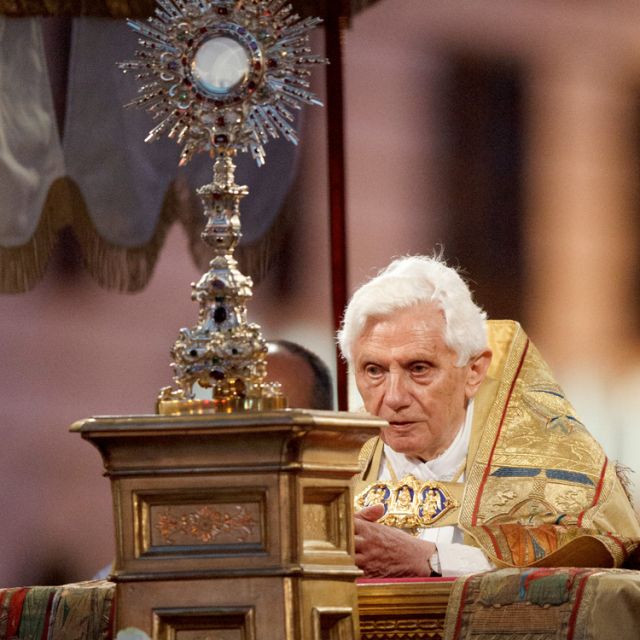
It had been moving also to be with the crowd in the square before St. John Lateran. There a small beloved figure with very white hair and a rather brown face celebrated Mass for the Feast of Corpus Christi. Every time I see him in person, I am surprised by how little Pope Benedict XVI is. His stature is rather a contrast to his presence in the Church.
But it was easy to forget that the Holy Father was there. Mass was about Christ, first and foremost, in unity with the Father and the Holy Spirit, and not about Benedict XVI. He just happened to be there with us, and it was greatly cheering to me to suddenly look up from my prayers and remember, “Oh, goodness! There’s the Holy Father with us today!”
The Holy Father has long been interested in liturgy, and his gentle corrections to the errors of the past 40 years were obvious. The choirs sang the actual propers, not hymns replacing the propers, and in Gregorian chant. The Kyrie was in Greek. The Gloria, the Creed, the Sanctus, the Pater Noster and the Agnus Dei were in Latin. The Holy Father said the entire Canon in Latin. Booklets had been handed out so those with no clue could read along in Italian or English. Thus the only part of the Mass that most pilgrims would not have understood at all was the unpublished homily, which was in Italian, language of the local diocese.
After Mass, the choirs sang hymns in Latin and Italian. The Blessed Sacrament was brought in a monstrance to a motorized covered white platform, and shortly afterwards Benedict took a seat on this platform, behind the monstrance. The machine slowly moved forward, and the hundred or so in chairs and the thousands standing slowly oozed away from St. John Lateran into the street.
We followed after Christ and Peter in the dark, many holding candles protected by shades, as loudspeakers all along the Via Merulana broadcast the Lateran choir’s hymns, Gospel readings and prayers. Banners celebrating the Blessed Sacrament hung from churches and convents. Pious families living along the route hung out their best white lace tablecloths or red and white streamers. Tourists goggled or, frowning, cut anxiously across the procession to get to the other side of the street. We swept on.
The crowd packed the piazza in front of Santa Maria Maggiore for Benediction. Mark could see when the Holy Father held up the monstrance, and we plunked to our knees. I was sorry that most of the crowd did not, for gesture is so important. But, nevertheless, it was a great experience.
Dorothy Cummings McLean