Philly priest released from prison after court reversed conviction
By Catholic News Service
January 3, 2014
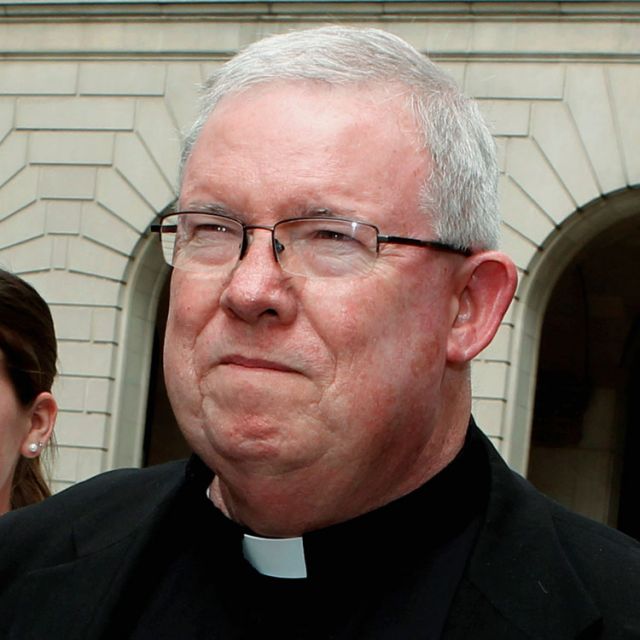
PHILADELPHIA - A Philadelphia archdiocesan priest was released from a Pennsylvania state prison Jan. 2 after an appeals court reversed his conviction for endangering child welfare by his handling of a sex abuse case.
After leaving the prison in Waymart, where he had served 18 months of his sentence, Msgr. William Lynn, former secretary for clergy for the Philadelphia archdiocese, was fitted with an electronic monitoring device. One of his lawyers, who told The Associated Press that the priest would likely be released to the custody of a family member, declined to say where Lynn would live while prosecutors appealed the Superior Court ruling.
Bond was set at $250,000 for Lynn Dec. 30, four days after an appeals court reversed his conviction. The priest was told by Common Pleas Court Judge Teresa Sarmina to surrender his passport and submit to electronic monitoring and weekly reporting while out on bail.
On Dec. 26, a panel of judges for a Pennsylvania Superior Court reversed the priest's conviction in handling a clerical abuse case and ordered his release from prison. Sarmina told the courtroom Dec. 30 that she had been grappling with how to respond and that she considered simply affirming her original ruling and continuing to deny bail.
Sarmina had rejected Lynn's requests for bail during his 2012 trial and while his case was on appeal. But because the higher court ruled she had erred in applying the law under which Lynn was convicted, she said Dec. 30 that she had to acknowledge that if the conviction was in question, the punishment also would be in question.
Lynn has served 18 months of a 2012 prison sentence of three to six years after he was found guilty of endangering the welfare of a child, a felony.
Prosecutors had argued that the priest had reassigned abusive priests to new parishes in the Philadelphia archdiocese in his diocesan role as clergy secretary. However, Lynn's attorneys argued that Pennsylvania's child-endangerment law at the time applied only to parents and caregivers, not to supervisors, which was Lynn's role.
The Superior Court's 43-page opinion described Lynn's conviction under the state's original child endangerment law of 1972 as "fundamentally flawed." It noted that the original meaning of the statute, revised in 2007, required a person who was not a parent or guardian of the endangered child to "at least be engaged in the supervision, or be responsible for the supervision" of the child. The court said the "evidence was insufficient" to demonstrate that Lynn "acted with the intent of promoting or facilitating" child endangerment.
The court's ruling, written by Judge Joseph D. Seletyn, also concluded that there was no evidence that Lynn knew of the victim of sexual abuse at St. Jerome parish or that he conspired with the accused priest's plans to abuse the boy.
Prosecutors could appeal the Superior Court panel's decision or ask the full Superior Court to rehear the case.
A statement from the Philadelphia archdiocese said the Dec. 26 decision "does not and will not alter the Church's commitment to assist and support the survivors of sexual abuse on their journey toward healing or our dedicated efforts to ensure that all young people in our care are safe." The statement promised vigilance in child protection and said, "The reputation of the Church can only be rebuilt through transparency, honesty and a fulfilment of our responsibility to the young people in our care and the victims and survivors who need our support."
Lynn, 62, who recommended priest assignments to the archbishop of Philadelphia and investigated claims of sexual abuse of minors by clergy from 1992 to 2004, became the first official of the U.S. Catholic Church to be convicted of a felony for his responsibilities in managing priests, some of whom abused children. His conviction was based on the case of former priest Edward Avery, who admitted he had sexually assaulted a 10-year-old altar boy at his northeast Philadelphia parish in 1999. The former priest, laicized in 2006, is serving a sentence of two-and-a half to five years in prison. Earlier this year, Avery said he never touched the boy and only entered his guilty plea to get a lighter sentence.
The Seletyn opinion acknowledged one of the prosecutors' central claims, which formed the main argument of Philadelphia grand jury reports in 2005 and 2011: that for decades archdiocesan administrators at the highest levels dealt poorly with child sexual assault by some clergy; and that administrators such as Lynn appeared to prioritize the "disrepute" of the Church over safeguarding children in the Church.
But the judge said this was not the issue in the Lynn case. Rather, the priest could not be charged, tried and convicted for his actions not to remove priests before they abused children according to a law written after the time in which he served.
A statement by the Survivors Network of those Abused by Priests, or SNAP, said the group was "heartsick over this decision" and that "thousands of betrayed Catholics and wounded victims will be disheartened by this news."