What a difference to be found in two Masses
By Dorothy Cummings McLean
February 20, 2014
Dorothy Cummings McLean
Foolishly I read only half the memo: the Oratorian’s Missa Cantata for Candlemas would not only be at 10:45, it would be at Holy Family Church in Parkdale. I discovered my mistake only at 10:40 a.m., when I was happily chatting at the back of St. Vincent de Paul on Roncesvalles.
“You can still make it,” said my friend soothingly.
But it was cold, I was out of change for the streetcar, my bank was a long walk in the opposite direction and I had a Polish missal with me, so I swallowed my disappointment and just went across the street to St. Casimir’s.
I once got fired from a Catholic newspaper by writing about how odd it is to attend the Novus Ordo after months of assisting at the Extraordinary Form. But it is odd, because although it is unpopular to say so, the Novus Ordo is different from the Extraordinary Form. No matter what language it is said in, the average priest ad libs like mad. I can’t but help think of the disappointment of all the Catholics who ran away to gurus in the 1960s if their meditation sessions had been prefaced with, “Welcome! How’s it going? How ’bout those Leafs, eh?”
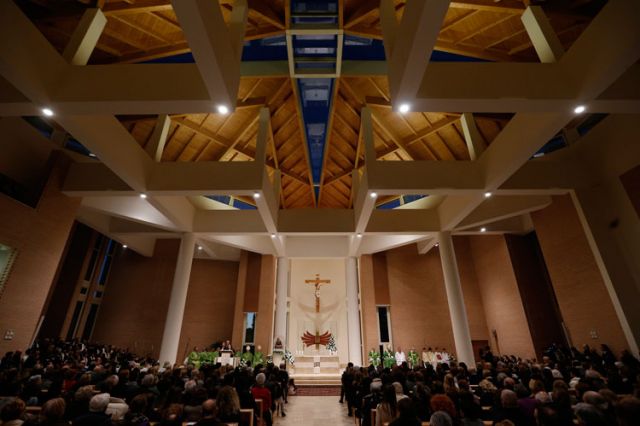
That said, some priests and congregations do their best to preserve the dignity and mystery of Mass. This is particularly true in Polish communities, and in greying Edinburgh the Polish Masses offer the added bonus of so many young married couples and their babies. I noticed only one baby in Toronto’s St. Casimir’s on Candlemas. Although it was the third Mass that Sunday, the pews were completely filled and latecomers had to stand in the back. Some of the congregants had brought traditional candles to Mass with them, and the priest processed down the aisle with an asperger to bless them.
In recognition that the Christmas season does not end until Candlemas, there were still Christmas trees behind the altar and the beautiful Nativity scene visible to our right. The hymns were heartfelt, the silences profound. And when the priest ad-libbed I was blissfully undistracted from the words of the Mass for, although I can read the Mass in Polish, spoken Polish is another story.
St. Casimir’s lovely celebration was a contrast to the Sunday Mass I attended the next week in rural Quebec. The church had been beautiful and still had lovely bones, but someone had decided that instead of facing east, towards the dawn that represents our Lord’s return, the congregation should turn clockwise and gather on three sides around a new altar on a platform, facing Florida. The tabernacle was nowhere to be seen — a difficulty for people who want to genuflect to God Himself, not the man-made altar.
“They have taken away my Lord and I do not know where they have laid Him,” I said to my host, and began a search. I found Him at last in what used to be the baptistry.
The youngest person in the church was 41, but the choir and congregation sang with youthful vigour. The priest cracked several jokes, and the congregation laughed heartily. I lost my place in the missal several times. I was well and truly disconbobulated. Indeed, I was so confused that when we reached the consecration, for the first time in my life, I was not sure the Mass I was hearing was valid. That said, I am not sure it wasn’t. Is the consecration still valid if it is sung by priest and people in a call-answer format? What if the priest sings part and the people sing part? How many liberties can be taken with the words and rubrics of the Mass before Mass isn’t Mass any more?
“I am not asking to make trouble,” I said to my host. “I am not going to contact him or do anything with this information. But who is your bishop?”
My host was stumped.
“I don’t know,” he admitted. “We never pray for him.”
One of the solutions of the Council of Trent (1545-1563) to Reformers’ critiques was uniformity within a rite. Trent allowed for several rites, not just the Roman, as long as they were of ancient use. However, Trent admitted that liturgical abuses within the rites were widespread, with priests omitting important prayers and adding unfitting new ones. In addition, local changes to the text of the Mass led to serious distortions. Trent took steps to correct this.
Given the continuing abuse of the vulnerable Novus Ordo, is it time for Trent II?
(Cummings McLean is a Canadian writer and author of Ceremony of Innocence.)
Dorothy Cummings McLean