Salvifici Doloris turns 30
By Fr. Raymond J. de Souza
February 20, 2014
Fr. Raymond de Souza
Last week, Feb. 11 was marked everywhere in the Catholic world as the first anniversary of the abdication announcement of Benedict XVI. Understandably so, for it was without precedent — the very definition of news — and it opened the door for a renewed energy and enthusiasm under Pope Francis.
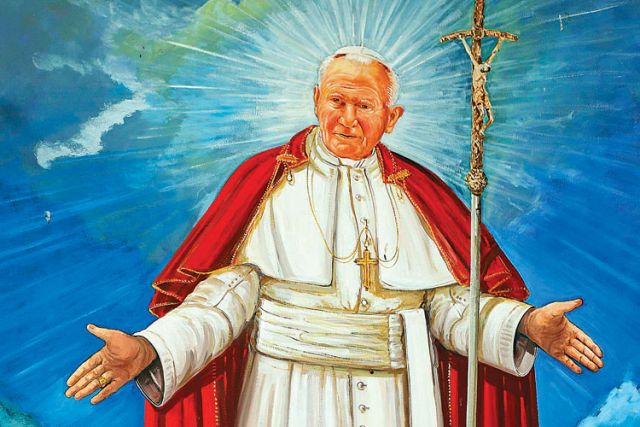
Yet Feb. 11 marked another anniversary, not newsworthy, but noteworthy nonetheless. On Feb. 11, 1984, Blessed John Paul published his apostolic letter Salvifici Doloris — Salvific Suffering. Thirty years later, the document remains one of the most outstanding amongst the dozens that John Paul wrote, and one of those most distinctively his. Written in the years after the assassination attempt of May 1981, the Holy Father reflects on the phenomenon of suffering and its link to the transcendent dimension of man, which is his capacity to know good and evil.
“Even though man knows and is close to the sufferings of the animal world, nevertheless what we express by the word ‘suffering’ seems to be particularly essential to the nature of man,” John Paul begins. “It is as deep as man himself, precisely because it manifests in its own way that depth which is proper to man, and in its own way surpasses it. Suffering seems to belong to man’s transcendence: it is one of those points in which man is in a certain sense ‘destined’ to go beyond himself, and he is called to this in a mysterious way.”
Fr. Raymond de Souza