The sad story of a dying soul
By Dorothy Cummings McLean
May 29, 2014
Dorothy Cummings McLean
I was a child when John Lennon was shot and killed in New York. My mother asked me not to remember the name of Lennon’s killer, as the reason he had shot the musician was to be remembered. And since that day I have done my best not to remember or repeat the names of those who kill for fame.
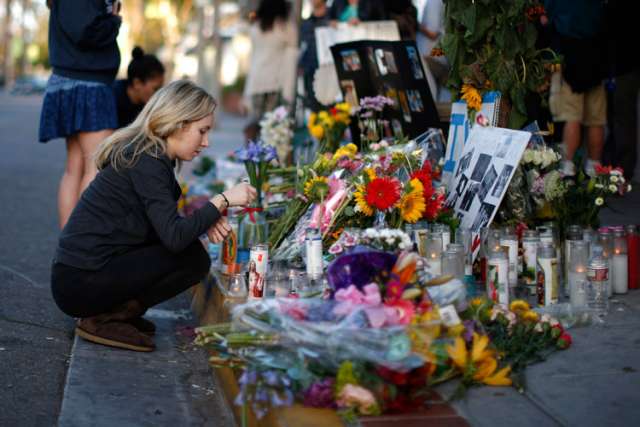
Thus I find myself in a difficult position regarding the 22-year-old in California who on May 23 killed six people, wounded more than a dozen more and then killed himself. On the one hand, I don’t want to name him, but on the other I think parents, teachers and priests should read his memoirs.
The Santa Barbara murderer, as I will call him, wrote a 141-page autobiography before he embarked on what he called his “retribution.” According to news reports, the murderer wanted revenge upon the world because he had never had a girlfriend. I wondered if he were completely insane, or if a sense of entitlement — a belief that the world owed him a girlfriend, or that girls owed him sex — had made him a monster, so I began to read his book.
His is not an original motive. In 2009, a Pennsylvania man shot 12 people in a health club because he couldn’t find a girlfriend. Like the Santa Barbara murderer, the Pennsylvania man left a manifesto, which I read. But there is a chilling difference between the two documents. The 48-year-old Pennsylvania murderer was not a talented writer; the 22-year-old Santa Barbara murderer was.
I say “chilling” because as I read I found myself moving from anger and contempt at the murderer’s violence to grudging admiration for his writing talent. Apparently possessing a phenomenal memory, he has written a compelling, if self-obsessed, memoir of what it was like to be a child of his generation brought up by upwardly mobile parents. He has a sophisticated writing style and an unusually good grasp of grammar. His story makes for compelling, if sickening, reading.
The work is an indictment not only of the killer — had he known it — but of the environment he grew up in. And it was not an environment of guns — let’s not kid ourselves. It was a privileged world awash with hedonism, divorce, status-seeking, mindless entertainment and macho bragging about sex. Macho bragging about sex, memorably at a “Catholic” boys’ high school, sent the killer into paroxysms of envy and rage.
I mention the Catholic high school because it seems to have been the only brush with Christianity the memoirist-murderer ever had. His tale is otherwise devoid of any hint of Christian faith. His father, a Hollywood director, lost a large sum of money on a film about religious beliefs, but the only religious beliefs the young murderer held, however briefly, were from a pop-spirituality book called The Secret. He hoped the think-good-things-and-they-will-happen discipline of the book would help him win millions in a lottery.
The millions the murderer hoped to win were supposed to give him a happy new life in which he had the respect of fellow men and, above all, the love, attention and bodies of beautiful women. As he grew up, the murderer believed that money was the secret of happiness. His divorced father’s lavish lifestyle gave him a taste for luxury while starving him of his father’s attention. His divorced mother bought him whatever he wanted, but inadvertently reduced his social status at school when she had to move to a poorer neighbourhood. When his mother became the girlfriend of a multi-millionaire, the murderer rejoiced. He had enjoyed her status as a friend of director George Lucas; now he hoped for a wealthy stepfather.
There is so much in the autobiography that suggests why the young man’s life ended in a murderous rampage. The porn shown to him by a stranger over the Internet when he was 11. The years of isolation when he was addicted to playing video games. His father’s frequent absences. But above all, the feelings of injustice and entitlement that grew as he grew older.
At press time, I am only two-thirds of the way through his narrative, but so far no one has told him that human beings get their worth not from money, beauty, intelligence or sex but from being made in the image and likeness of God. He has not heard the Gospel, but he sure knows his video games, the Star Wars franchise and Game of Thrones. He has no shame as he writes; he holds nothing back — his fears, his tears, his tantrums. It’s as if no one he loved ever told him his gross self-indulgence was wrong. Maybe no one he loved ever did.
(Cummings McLean is a Canadian writer and author of Ceremony of Innocence.)
Dorothy Cummings McLean