Where the Christians’ cries go unheard
By Dorothy Cummings McLean
February 26, 2015
Dorothy Cummings McLean
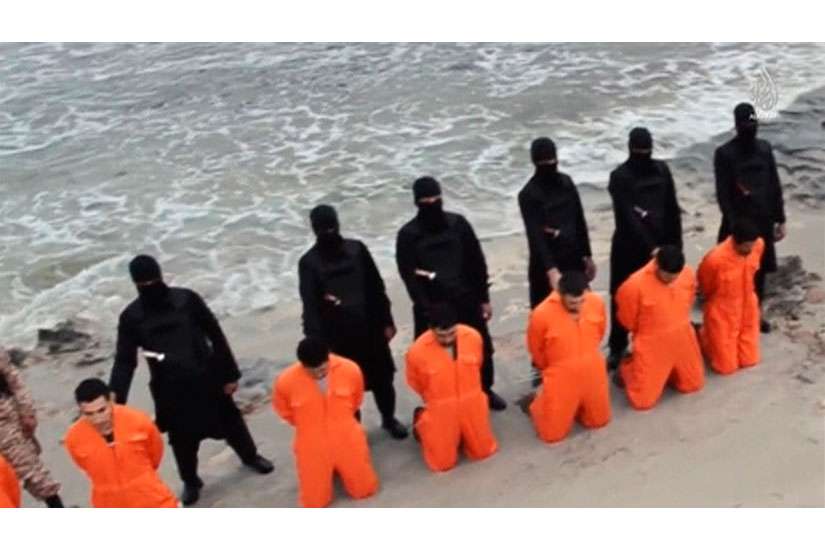
Twenty-one Christians had their throats cut on a Libyan beach facing Europe — or so their murderers want us to think. Some shots may be faked — ocean and sand added with video tricks. Even so, the massacre was a message to Europe, meaning “You’re next.” The Islamic so-called State hopes to invade Rome and fly its black flag over St. Peter’s Basilica.
Romans are satirically tweeting traffic advice.
But are IS’s threats so ludicrous? It has an army only hundreds of kilometres away from Lampedusa and Sicily where tens of thousands of migrants have been washing up, alive or dead, for years. Italian Catholics rescue the migrants, blanket them, feed them, give them medical attention and shelter. Now the Islamic State is threatening to follow them, to pretend to be them — migrants trafficked from Libya. They would reward the kindness received from Italians with murder and mayhem.
I am not currently in Europe. I am visiting family in a tranquil, snowy village in Quebec’s Eastern Townships. My brother’s house is generous, cozy, full of winter sun and yet well-insulated from draughts. Warm and safe, I watch from a comfortable leather sofa as snow falls gently on the pretty, quiet street and the frozen lake behind it.
My brother and sister-in-law are friendly, cultured people, well-liked in the village. Their children are adorable. The local café has delicious maple syrup cake — and I don’t want to think about the horrible suffering of African and Middle Eastern Christians at the hands of Islamists. My last three columns — on the decline of the priesthood, on protesting abortion, on blasphemy — were heavy-hitting. Isn’t it time for a break from sorrow? Sure, Christians far away are persecuted, but we’re not them, are we? I went to the village church in perfect safety this morning, and there was not a word about the 21 dead Christians to take the sparkle off my Lenten Sunday morning. Sing hosannas!
But it’s a small world, and I keep thinking about Christians in the Middle East. Two days ago my brother drove me to see friends in Vermont. Vermont is also covered in snow. The countryside, with its charming farmhouses and dairy cows, looks like a children’s picture book. The people are friendly; the drivers considerate. The view from the windshield was marvellously cheerful, and yet something about the wide expanse of snow prompted me to say, “It must have been so weird for the local boys when they were in Afghanistan.” It was a shot in the dark — what do I know about military recruitment in small-town Vermont? But, sure enough, “There’s photos in the opera house of the ones who didn’t make it back,” my brother replied.
I’m trying to drown sad thoughts in peaceful Canadian family life. The bloody war against Christians is far away — for me, 5,000 km farther away than usual. I haven’t even been to Montreal, where there’s a big Middle Eastern Christian community. And our Lebanese friend Jean-Baptiste couldn’t make it out of the city for the party last night.
It was a wonderful party. Men and women, anglophones and francophones, mingled happily and ate sausage rolls before and after my brother’s living-room recital. He played preludes by Chopin (Opus 28) and Scriabin (Opus 11) and accompanied another friend, a heavily pregnant mezzo-soprano, as she sang arias by Mozart. The children, girls and a boy, played heartily downstairs.
And as I listened to my brother play Chopin, I thought about how Jan Sobieski lifted the siege of Vienna in 1683, saving Christian Europe from the Ottoman Empire. I wondered if Chopin is still played in cosmopolitan homes in Tikrit and Mosul, and if IS hates music as much as the Taliban does? IS probably isn’t keen on men and women sitting together at parties, heavily pregnant professional singers appearing at them, or anyone eating sausage rolls. I tried to imagine armed men bursting in the door, yelling prayers and abuse. But it couldn’t happen here. Not here. So why think about it?
When the performances were done, my nephew marched the girls upstairs at Lego gunpoint, their hands in the air. The adults laughed. My nephew then pretended to lock the girls in a prison made from plastic tubes. When they were bored, the girls kicked the prison to bits and ran away. My small niece took refuge beside me in my guest bedroom retreat from adult chatter.
“What do you want to be when you grow up?” I asked her.
With her dark hair and blue eyes, she could be Syrian. Or Sicilian.
“I want to be a doctor,” she said.
“Good girl,” I said sleepily.
Outside the snow fell gently on the frozen beach.
(Cummings McLean is a Canadian writer and author of Ceremony of Innocence.)
Dorothy Cummings McLean