What wasn’t heard on Palestine
By Fr. Raymond J. de Souza
May 21, 2015
Fr. Raymond de Souza
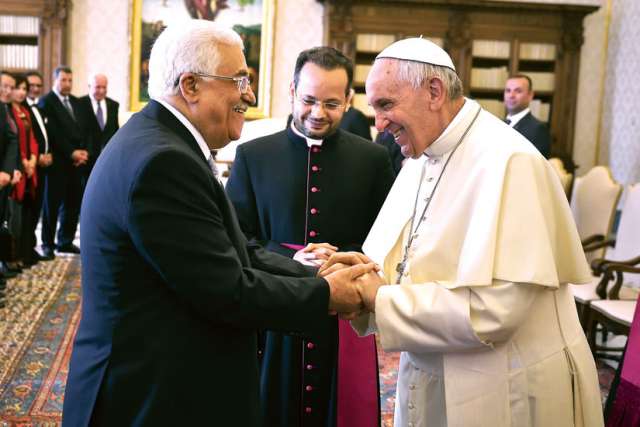
It was Palestinian Week in Rome. The Holy See recognized the “State of Palestine.” The Holy Father called Palestinian President Mahmoud Abbas an “angel of peace.” Two Palestinian saints were canonized. Or so it appeared in the world’s press. Not for the first time under Pope Francis, what was reported was not exactly what happened.
Fifteen years ago, the Holy See concluded a “basic agreement” with the Palestine Liberation Organization, as the then-representative of the Palestinian people. After the Oslo Accords of 1993, which the PLO concluded with Israel, the PLO governed the Palestinian Authority in some parts of the West Bank and in Gaza. The “basic agreement” of 2000 was a rough equivalent of diplomatic relations between the Holy See and the Palestinian Authority, which was not then a recognized state.
In 1993, when the Holy See established diplomatic relations with the State of Israel, a decision was taken to establish relations by means of a “fundamental agreement” which would then lead to a more detailed “final agreement.” The latter would treat the Church’s legal personality as Israel, and would specify matters of religious freedom, property holdings and taxation. The same process was used for the PLO in 2000 — first the “basic agreement” followed by a more detailed text.
Fr. Raymond de Souza