Vatican paper: exploring the final frontier, Star Trek offered peace
By David Gibson, Religion News Service
September 8, 2016
Accolades for “Star Trek” are filling the internet on the 50th anniversary of the television show’s premiere back on Sept. 8, 1966, and now the Pope’s newspaper has joined the chorus of hosannas for one of the most popular franchises in entertainment history.
But the brief homage by Giuseppe Fiorentino, second-in-command at L’Osservatore Romano, is not so much about the show’s artistic merits as it is about the message that “Star Trek” conveyed to a world afflicted by so many tensions – a world much like the present day.
“Millions of people loved the intergalactic adventures of Captain Kirk and his faithful crew because during those years of the Cold War – while builders of atomic bomb shelters were raking in money, especially in the U.S. – ‘Star Trek’ presented a model of true cooperation,” Fiorentino writes in Friday’s edition of the Vatican daily, which was on Roman newsstands late Thursday (Sept. 8).
The goal of the voyages of the Starship Enterprise, Fiorentino says, was to discover new civilizations and “propose peaceful relations on the basis of equality.”
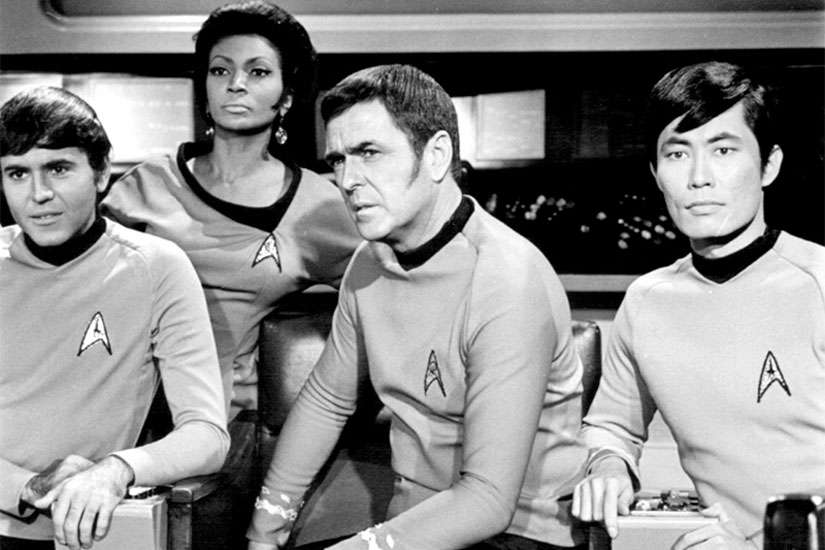
In that mission, Kirk was assisted by a crew of racially and ethnically diverse people from Earth but also by aliens, most famously Mr. Spock, who had a Vulcan father and a human mother.
While such diversity “might seem completely normal” today, Fiorentino writes, the 1960s were an era of domestic upheaval and racial tension in the U.S. and acrimonious relations with the Soviet Union and its allies.
By dealing with such themes, Fiorentino writes, “Star Trek” was “an interstellar journey that was completely human, that is, searching for new ways to understand ourselves – a journey that we must always be undertaking.”