This article has been imported from our web archive. As a result, it may contain formatting errors, broken links or images, or other inconsistencies from the original publication.
Oratorio combines music and theology
March 10, 2018
Singing along with Christmas is easy. Easter oratorios are always a big draw. But Lent is often left off our musical diet.
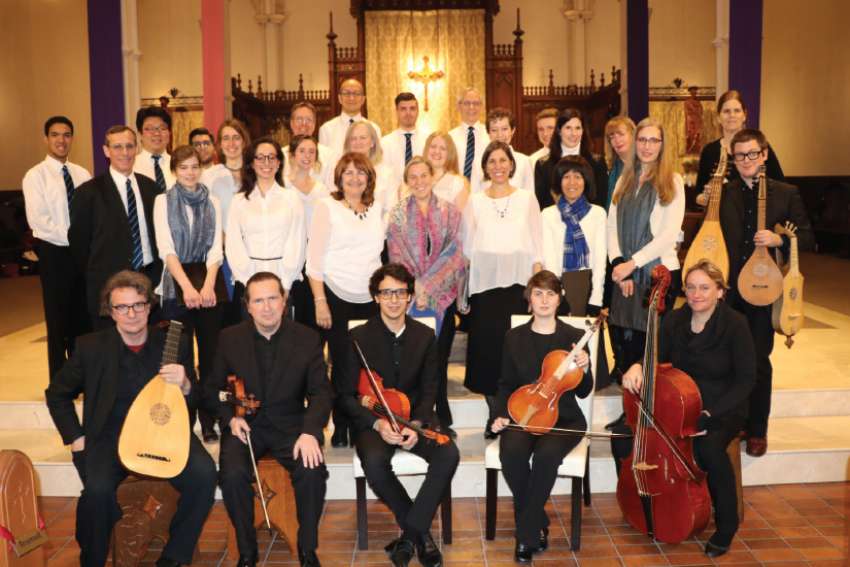
The Musicians in Ordinary and the St. Michael’s College Schola Cantorum plan to erase that musical void with a March 24 performance of Dieterich Buxtehude’s “Membra Jesu Nostri.” This small-scale oratorio from the 1680s, by the composer who taught Johann Sebastian Bach, combines great music with excellent theology, said Musicians in Ordinary founder and senior lecturer in the St. Michael’s Christianity and Culture program Michael O’Connor.
“It is really gorgeous music,” O’Connor told The Catholic Register.
Scored for voices in five parts with a small string ensemble, the oratorio has seven cantatas or movements which guide the listener in meditation on the crucified body of Jesus.
“That kind of contemplative gaze on Christ in suffering, seeing all that in terms of both pity and also tenderness and passion, it’s a very interesting conjunction of the sort of affective Mediaeval piety with Baroque piety,” O’Connor said.
The Danish-German composer put together music that seems almost free-form compared to the tight, mathematical precision associated with Bach. But his aim first and foremost is to serve a text which combines poetry, likely composed by a Cistercian monk in the 13th century, with passages of Scripture.
“Whoever did it, whether it was Buxtehude himself or somebody else, it is a very skillful piece of textual tapestry, a weaving together of these different elements,” said O’Connor.
Each cantata or movement concentrates on a different part of Christ’s body, beginning at the feet and climaxing at the face.
The concentration on Jesus’ humanity and His suffering brings home important messages about salvation, the Church and the sacraments, according to O’Connor.
“Thinking about Christ as flesh and blood is always something that will strike us and will nourish us in our meditation,” he said. “But also in the way we will think about Eucharist. Also in the way we think about Baptism…
“If we think about our redemption being achieved by the suffering and death of Jesus and then His resurrection, these are moments in somebody’s bodily existence. It’s not some kind of abstract sort of transcendent intervention. It’s a real body that suffered and died.”
The 8:00 p.m. concert at St. Basil’s Church, 50 St. Joseph St. at Bay, is free, though they will pass the collection baskets around for a free-will offering. There’s more information at www.musiciansinordinary.ca or by calling (416) 926-7148.