The origins of Christian art
By Carol Glatz, Catholic News Service
June 15, 2011
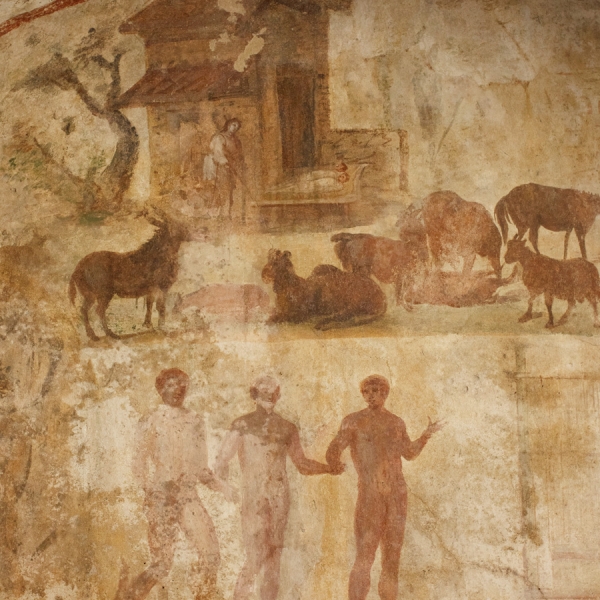
VATICAN CITY - A newly restored third-century family tomb shows the gradual flowering of Christian funerary art as it grew out of ancient Rome’s multireligious and pagan cultures, said Vatican archaeologists.
While early Christian catacombs offer clearer examples of early Christian iconography, the burial chambers of the Aureli family mix pagan, Christian and Gnostic symbolism, representing “an evolving cultural process” at work in Rome at the time, said Msgr. Giovanni Carru at the June 9 unveiling of the tomb.
The figures on the tomb’s walls are “the first step toward the religious transformation of the city” of Rome, from being a rich mix of pagan cults, Jewish thought and Christianity to a culture that came to embrace Christianity both as a religion and a new source of ideas and art, said Carru.
The white walls of the three burial chambers are decorated with great philosophers, colorful animals and bucolic scenery, and scenes from Homer’s “The Odyssey.”
There are also fragmentary images of a woman seated with a snake underfoot and a man creating smaller men by his side.
There is much debate over who these figures could be: either Eve in the Garden of Eden and the creation of Adam or a nymph in the garden of the Hesperides and Prometheus creating man, said Fabrizio Bisconti, the commission’s archaeological superintendent.
Bisconti said the overarching theme throughout the multilayered tomb is one of awaiting the afterlife, being “suspended in the cosmos,” balancing between the earthly world and a supernatural one, all of which is fertile ground for the Christian world of heaven.
The iconographic mix shows the multireligious and tolerant climate that reigned between the second and third centuries and before the persecutions of Christians by emperors Valerian and Diocletian intensified